
On the Russian blacklist
The most successful Russian operation in Europe is not assassination. It is the vote that softened, the dossier redirected, the speech that did not happen. Until we count it, we cannot answer it.
Russia seeks to undermine European decision-making through fear, pressure, and uncertainty. Russian intelligence services maintain a database of roughly 4,000 to 5,000 European politicians, journalists, civil-society figures, business leaders, and researchers judged hostile to Kremlin interests. Too often, these blacklists are treated simply as lists. They are not. They are part of a coercive architecture.
Their purpose is not only to identify targets. It is to shape behaviour. The evidence suggests that these lists are evolving from passive exclusion registers into operational hit lists. But there is an effect that standard analysis still fails to capture: anticipatory self-censorship caused by the very existence of the list itself.
This is the point I raised in my recent remarks and in my interview with Politico: the Kremlin wants European decision-makers to watch their words, soften their positions, and censor themselves before any direct pressure is even applied.
We must not allow that shadow to fall over our work.
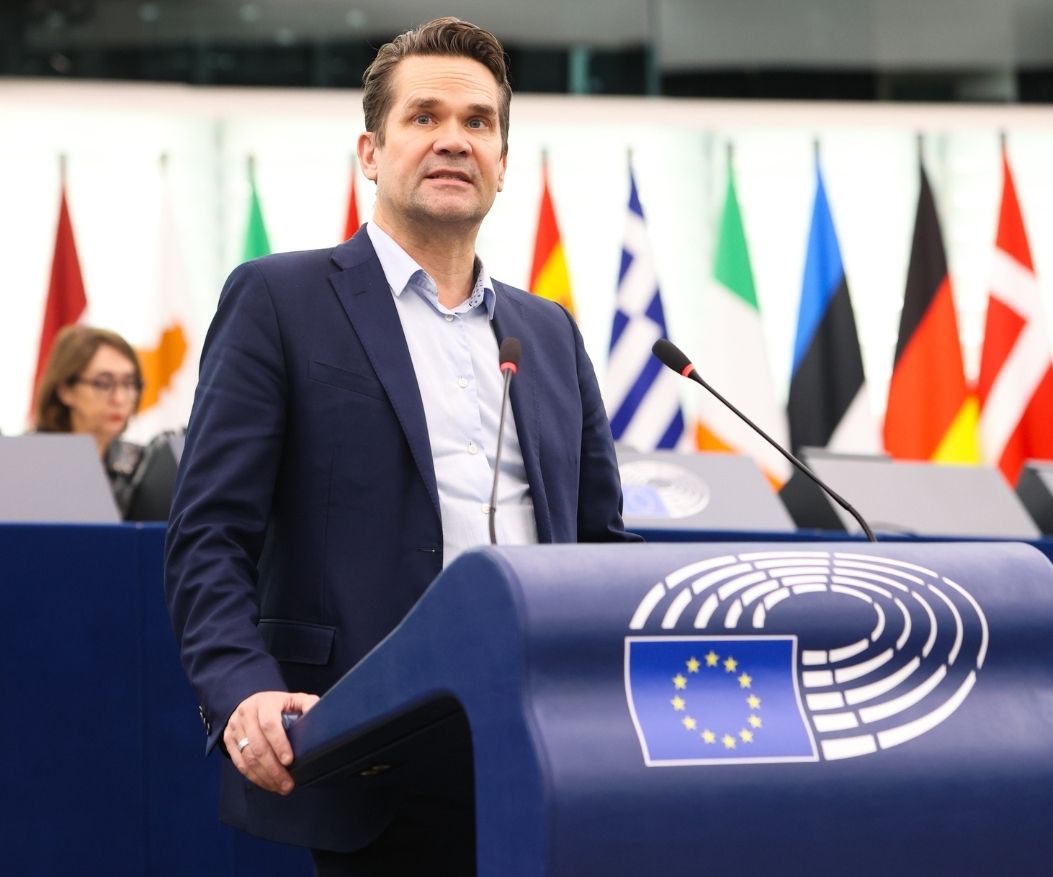
Inside the European Parliament, I have actively advanced this issue in the Special Committee on the European Democracy Shield, where I serve as EPP Coordinator. Understanding the real nature of these threats is essential for protecting our democracy. I am therefore pleased that the issue has been included in the EUDS final report, which was voted through at committee level this week.
We must be able to do our work freely. Without pressure. Without the shadow of the Kremlin.
More on this threat environment in my column below.
An escalating Threat to European democracy
This June, it was revealed that the now-resigned prime minister of the UK had been the target of a Russian arson operation. He had been blacklisted by Russia in 2022. Bad luck kept following him.
In November 2025, according to media reports, the Belgian prime minister received a warning from Russia: “we will burn down your house”. The chief executive of Euroclear hired private bodyguards. The Belgian police had refused to provide protection. The executive sat on 185 billion euros of frozen Russian money, and Moscow had decided that the bank official should feel the weight of it personally. In the same weeks, drones crossed Brussels Airport until it closed. They crossed the Doel nuclear plant. They crossed an air base assessed to hold American warheads. None of it was an accident of timing. It was a message, written in the grammar Russia now prefers life-threatening pressure. The blacklist, or rather a game of multiple Russian blacklists, is increasingly looking like a political and physical target list.
On 19 December 2025, the intended message was received. EU leaders approved a loan for Ukraine and quietly dropped the plan to back it with Russian assets. A sovereign decision of a NATO and EU member state was shaped from the outside, without one Russian official setting foot in the room. The threat-game worked. The question is not whether Moscow will replicate it. The question is how often, and against which decision next. The list is not the threat. The list is the architecture.
I call this Tier Zero. It sits beneath every category our analysts count, because it leaves no evidence. A closed deliberation keeps no record of the position not taken. You cannot subpoena a sentence a colleague decided not to say. The most successful Russian operation in Europe is not the poisoning in Salisbury or the arson at a prime minister’s old house. It is the vote that is never cast. We do not measure it, because it does not bleed.
Set Tier Zero at the floor of a ladder. Above it stands the tiers we do count. Tier One is naming. A name read aloud on Russian state television, a face on a list a Telegram channel publishes, a denunciation that costs Moscow nothing and travels everywhere. Tier Two is pressure with a body to it. Surveillance, an intermediary who relays a threat, a drone over a headquarters during a state visit, a demonstration outside a home. Tier Three is the kinetic tier, rare and sensational by design. Arson at the right address, a nerve agent in a quiet English city, a plot against the chief executive of an arms manufacturer. Every tier above the floor bleeds and leaves evidence. We count those. Tier Zero leaves none, and that is why it does the most work.
The weapon draws its power from what it refuses to tell you. Russia denies the lists exist while its state television names the Russophobes nightly. A few are quietly told by their own services that they appear in adversary files. Most are told nothing, and silence is not safety, it is only ignorance. No one can know which act, on which day, in which combination, moves a person from the database into the operation Strategic ambiguity used to be a shield for the strong. Russia has turned it into a leash for the rest of us.
Here is the cruelty of the design. It does not need many operations. A handful of demonstrations, one poisoning, one arson at the right address, one segment on Moscow television, and the fear does the rest of the work on its own. A few sensational cases produce a continent of officials quietly adjusting their conduct. The disproportion between the operations and the behaviour is not a flaw in the machine. It is the machine. We live now inside a kind of background radiation, and you cannot point to the rung you are standing on, because there is no rung.
Put a face on it. Pina Picierno, a vice-president of this Parliament, carries a panic button. She crossed Russian state media once too sharply, and now she moves with an escort. She is not on my side of the house, and that is the point. The list does not check your political group before it reaches you. And the people it reaches are routinely the last to know they have been reached. The German industrialist Armin Papperger learned of the plot on his life from American services, not his own. Sergei Skripal was known to British intelligence and warned by no one. This is not the failure of any single officer. It is a hole where a duty should be.
There is a darker symmetry underneath. The same apparatus that marks anti-Kremlin members as targets also runs pro-Kremlin members as assets, for years at a time, as the case of the bribed MEP Ždanoka showed. So Moscow knows exactly who its enemies are. It also knows exactly who its friends are. We know neither with the same certainty. That is the asymmetry that should keep us awake. The adversary holds a complete map of a house whose own residents are working from rumour. Verified, is a cost the Union is already paying without measuring it.
You do not out-mediate a state that trades in fear. You raise the cost of the thing it does cheaply.
The answer is not symmetry of method. We will never run kinetic blacklists, and we would rot the institutions we are defending if we tried. The answer is symmetry of stakes. Write a duty to warn into law, a European Intelligence Law, so that being listed brings protection instead of silence. Measure Tier Zero honestly, so the largest effect on our democracy stops living off the books. And build a lawful personal-cost regime against the people who run the architecture, the named handlers of Unit 29155, the brokers in third countries, the managers who launder the payments. Russia has made our representatives’ lives personal. The reply must be equally personal, and entirely within the law. A shield with gaps on the inside is not a shield. We should not only shield, and imperfectly at that. We should keep enough spark to carry a sword.
The question is no longer whether the Russia game works. Belgium answered that. The question is how many more times Moscow runs it before we decide that being targeted is not the same as being beaten.
Mika Aaltola on europarlamentaarikko (EPP) ja Suomen johtava ulko- ja turvallisuuspolitiikan asiantuntija. Aaltola on erikoistunut geopolitiikkaan, EU:n puolustuspolitiikkaan, transatlanttisiin suhteisiin ja arktiseen strategiaan.
What Europe Will Not Name
What Europe will not nameIn late September, L’Express revealed a French government note on Russian...
Hajauttamisen aika
Hajauttamisen aikaYhden varassa eläminen on vaarallista. Sen tietää jokainen, joka on kasvanut...
Kumpi Suomi?
Kumpi Suomi?Suomea tarjotaan taas malliksi. Kuulen sen käytävillä Brysselissä, ja aina samalla...
0 kommenttia